The company that defined AI art just demoed a full-body ultrasound scanner and announced a division called Midjourney Medical [1][2]. It's tempting to dismiss this as an eccentric detour by David Holz. That would be a mistake. It's the most honest message the AI industry has sent in years: image and video generation is nearly solved, so nobody will build a decades-long business on it. The real game is about data the internet doesn't have. And Midjourney understood this first.
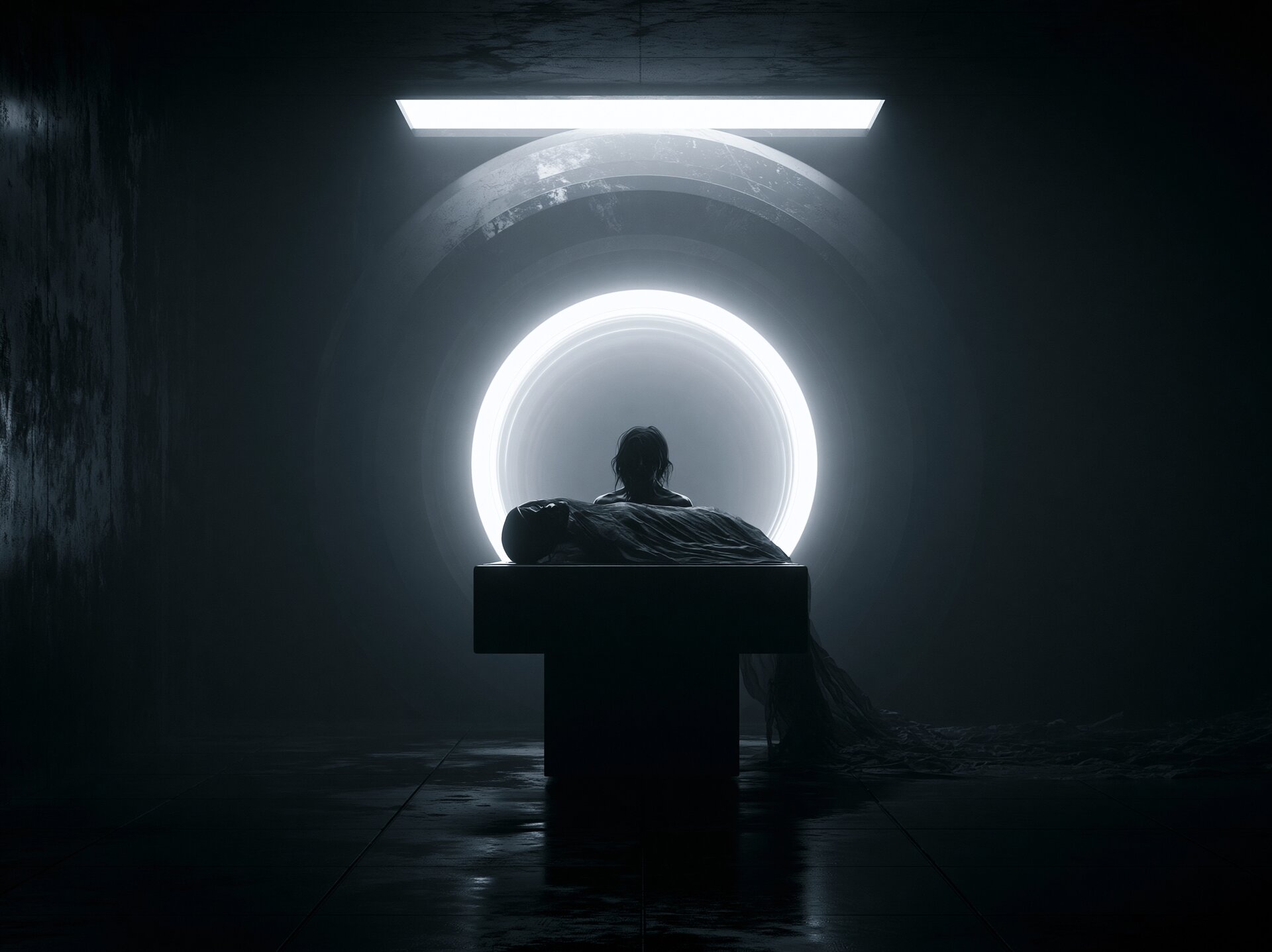
Midjourney Medical: scanning the body instead of generating images of it.
You can't build a moat out of pixels
Image and video synthesis is racing toward commodity status. Models leapfrog each other every quarter, quality gaps shrink, prices trend to zero. Sora, Veo, open models, generators baked into every app. When everyone can do the same thing, the margin disappears. The moat is no longer the model. The moat is data nobody else can reach.
When the category leader, instead of training yet another generator, builds hardware to scan human bodies, it's telling us something about the future of the entire market. Worth listening to more carefully than the next benchmark.
The internet has already been eaten
Every large model was trained on the same thing: the internet. Text, images, video - all scraped to the bone. The frontier is no longer in architectures but in new sources of data about reality. And the interior of the human body is arguably the largest undigitized dataset on Earth. Nobody has ever mapped it at population scale.
That's exactly why Midjourney wants over 50,000 scanners by 2031, with a combined capacity of a billion scans per month [3], feeding future AI models for early disease detection [1]. Holz admits openly that the scanner barely uses AI so far - at this stage it's just really cool hardware and software [4]. And that's the key to the whole story: the scanner isn't the product. The scanner is a data pump. The product comes later, out of a billion bodies.
The map gets sharper, the territory gets stranger
There's something deeper here that won't leave me alone. The last century of science is a triumph of method: we measure, predict, cure. Yet the same paradigm cannot answer the simplest question - what is the consciousness doing the observing.
AI pushes this paradox to the extreme. The models work, though we don't fully know why. Now Midjourney proposes the next step in the same direction: instead of a theory of disease, the statistics of a billion body cross-sections. Pure empiricism without understanding. It may well work - early detection at that scale would save lives. But we are building a civilization of maps that predict ever better and explain ever less. We scan the microcosm at sub-millimeter precision, and we still can't even define the observer inside.
A cold plunge, literally
For proportion: the prototype currently takes about 20 minutes instead of the promised 60 seconds, none of the image-quality claims has been independently verified, and the device has no FDA clearance [4][5]. Hence the spa strategy: scans positioned as wellness-grade "body composition maps" inside Midjourney Spas, the first opening in late 2027 in San Francisco, bundled with saunas and cold plunges [5][6].
Generated visualizations of a Midjourney Spa interior - two variants compared side by side.
Skeptics invoke Theranos, but the difference is fundamental: the physics of ultrasound tomography is well established, the hardware partner (Butterfly Network) is credible, and Holz has been candid about the limits [1][7]. The risk isn't fraud - it's the distance between a working demo and regulated medicine.
The takeaway
Holz built Leap Motion too early, Midjourney at the perfect moment, and now he's playing for something bigger than pictures: data nobody else has. If your business runs on generating content, treat this move as a memento. Content is heading to zero. Value flows to wherever unique data and unique access to reality live.
Images were the warm-up. Now the mapping of the world begins.
Sources
- Forbes, "Midjourney's Move Into Medicine Is A Bet On Data, Not Doctors" - forbes.com
- Fello AI, "Midjourney Scanner: AI Firm's Full-Body CT Device" - felloai.com
- Radiology Business, "AI lab Midjourney investing over $74M to launch whole-body ultrasound screening business" - radiologybusiness.com
- The Next Web, "Midjourney's full-body scanner: big claims, no track record" - thenextweb.com
- TechTimes, "Midjourney Full-Body Ultrasound Scanner Targets MRI Speed, But Prototype Runs 20 Minutes" - techtimes.com
- Business Insider, "Midjourney medical scanner / health care spa" - businessinsider.com
- Butterfly Network, press release on the Midjourney Scanner partnership - butterflynetwork.com
- The Verge, "Midjourney medical AI ultrasound body scanner lacks evidence" - theverge.com
- Contrary Research, "Midjourney Business Breakdown & Founding Story" - research.contrary.com