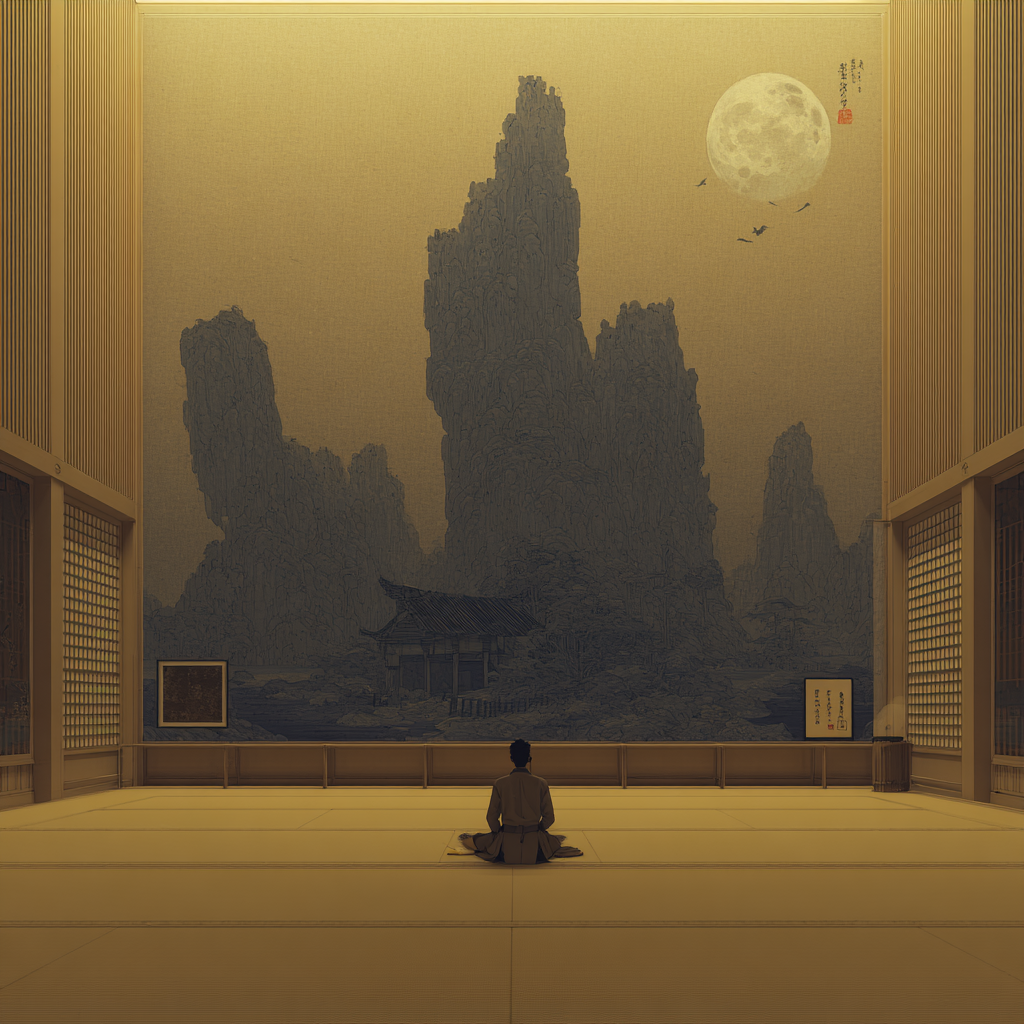
The Expert Myth
You're standing in a gallery. In front of you is a painting — abstract smears of colour. Next to you, a woman in black-framed glasses nods with understanding. "A fascinating dialogue with tradition," she tells her companion. "Do you see how it deconstructs the paradigm?"
You see smears.
You feel like a fraud. As if you're missing something obvious. As if art were only for the initiated — those who know the secret code, the magic words, the right gestures.
That's a lie. The biggest lie in the art world.
The truth is simpler and more democratic: valuable art is art that works. You don't need an art history degree to recognise it. You only need attention, time, and a little honesty with yourself.
The Test of Time
The first rule of recognising valuable art is brutal in its simplicity: come back to it.
Don't buy a painting at first sight. Don't give in to impulse in a gallery when the dealer says "this is the last copy of this edition." A valuable work will survive a week, a month, a year. A trendy trifle will vanish from your memory by Wednesday.
It works both ways. Sometimes you see a painting that seems dull, ordinary, nothing special. But you find your thoughts returning to it. Something in it stayed with you. A small hook caught on your consciousness and won't let go.
That is value. Not in the first wow effect, but in the lasting quality of the experience.
Collectors speak of "paintings you buy with your eyes, and paintings you buy with your heart." The first decorate a wall. The second become part of your life. Choose the second.
Technique vs. Concept
In one gallery hangs a painting: a photorealistic portrait of an elderly man, every wrinkle rendered with surgical precision. People stop, amazed. "Just like a photograph!" they say. "Incredible!"

In the adjacent room hangs a canvas covered with three broad brushstrokes. Just strokes. People look, shrug, and move on. "My child could have painted that."
Two questions: which painting requires greater talent? And which work is more valuable?
The answers might surprise you.
Technique — the ability to reproduce reality — matters. But it's only a language. Language alone doesn't make poetry. You can know every rule of grammar and never write a single moving sentence. Or you can break every rule and create something that changes someone's life.
Valuable art uses technique to express something beyond the technique itself. If a painting is merely a demonstration of skill — "look how well I can paint" — it's a circus, not art. An impressive circus, but a circus.
The question you should ask: what does this technique communicate? Why does the artist paint exactly this way?
Authenticity
This is the hardest to grasp, but the most important.
Valuable art doesn't pretend. It doesn't try to be someone else. It doesn't attempt to please everyone at once. It is brutally honest with itself.
You see it in van Gogh's work — that wild, terrifying sincerity. You see it in Frida Kahlo — pain painted without flattery. You even see it in the commercial Warhol — cynicism so genuine it becomes haunting.
Take Basquiat. Raw, unpolished canvases full of scrawls, crowns, fragments of text. No academic polish. But absolute authenticity — every painting screams "this is ME." You feel his rage, his energy, his pain. It cannot be faked. People have tried — dozens of artists imitated his style. All of them are dead on arrival. Because they copied the form, not the truth.
Authentic art doesn't ask "will they like me?" It asks: "is this real?"
How do you recognise authenticity? Ask yourself: could this artist have created something entirely different and still be themselves? If every painting by an artist could have been made by someone else, there is no authenticity there. That's a formula, not a voice.
Picasso said: "Good artists copy, great artists steal." He was joking — but also not. A great artist takes influences and digests them so completely that they become something new. You recognise a Picasso from a single line. You recognise a Rothko from a single field of colour.
That is authenticity. A voice so distinct it cannot be mistaken for anyone else's.
Complexity vs. Simplicity
The beginner collector's trap: thinking that complexity equals value.
I've seen paintings overloaded with symbols, metaphors, hidden meanings — an entire encyclopaedia packed into a single canvas. The artist can talk for hours about what each element means. And it's still empty work.
I've also seen a canvas with a single red line. Just a line. And it was the best piece in the gallery.
Look at Cy Twombly. His works look like a child's scribbles — chaotic lines, illegible text, blobs of paint. People say "my child could have done the same." But spend an hour with one of his paintings. You'll see that every line is placed exactly where it needs to be. This is not random chaos. It is composed chaos. The difference is like the gap between a shout and an opera.

Valuable art, whether complex or simple, shares one common trait: economy of means. Nothing in it is accidental. Nothing can be added or removed without damaging the whole.
Michelangelo said that the sculpture already exists within the stone — he merely removes everything superfluous. That is true of all good art. The artist removes everything that is not essential.
Sometimes a great deal remains. Sometimes very little remains. But it is always exactly as much as is needed.
Context and History
Here is the paradox: valuable art works on its own, yet you understand it more deeply when you know the context.
Picasso's "Guernica" is powerful even if you know nothing about the Spanish Civil War. But once you learn the history of the bombing, the work gains new dimensions of horror.
Malevich's black squares may seem absurd — until you understand that they were created at a moment when all Russian art was figurative and propagandist. Then you see that this was not provocation. It was an act of courage.
Context does not excuse weak art. But it explains good art. It shows why certain decisions were revolutionary, why certain gestures mattered.
If a painting requires a three-hour lecture to mean anything at all — it's a weak painting. But if a painting is powerful on its own, and context only adds depth — that is mature art.
Market and Value
The hardest truth: price does not equal value. In either direction.
I've seen paintings worth millions that were empty. I've seen works worth pennies that were genius. The art market is a speculative game, a theatre of snobbery, a casino. That doesn't mean you should ignore it — but you shouldn't trust it either.
Well-priced works usually share a few traits:
First, artistic consistency. An artist who develops one theme, one style, one vision over the years creates a narrative that the market understands and values.
Second, recognisability. It's not about fame, but about distinctiveness. Work you can identify as "that artist" in a single glance has a better chance of lasting value.
Third, quality of execution. Even the most conceptual work should be made well. Materials that won't survive a decade, technique that will fall apart — that's a bad investment.
But remember: you buy art for yourself, not for the market. Unless you're an investor — in which case it's no longer collecting, it's business. And that's an entirely different game.
Form and Content in the Age of Likes
Let's be honest: we're all playing the same game now.
Artists photograph their work for Instagram. Galleries design exhibitions with stories in mind. Collectors hang pieces partly because they'll look good in a photo at a party. This isn't a sin — it's reality. Art has always been social. Today society is online.
But there is one trap that's easy to fall into.
Take Banksy. A brilliant graphic artist, a perfect brand, instantly recognisable. His work performs perfectly on social media — a simple message, a clear image, viral potential. And that's where the problem lies. Not with Banksy — but with what he has become a symbol of.
Because when form becomes more important than content, when "Instagram-worthiness" is the primary criterion for creation — somewhere along the way, the soul gets lost.
The question is not: does your art look good in a photo? The question is: does anything remain when you put the phone down?
You can create beautiful, photogenic work that simultaneously has depth. Rothko photographs poorly — the colours are never true on a screen — but people still photograph him, because standing before the original they feel something. And that "something" is what they want to hold on to.
The problem begins when everything is designed only for that one scrolled second. Pastel abstractions that perfectly match beige minimalism. Neon slogans that sound profound but are hollow. Geometric forms technically perfect, emotionally dead.
That's not bad art. It's art that has forgotten why it exists. Art that puts virality above truth. Likes above experience.
I feel this myself when creating. That pressure to be "pretty," "shareable," "on-trend." It's unavoidable. But the key is not to lose what you wanted to say in the pursuit of how it will look. Form should serve content, not suffocate it.
So when you look at art — whether in a gallery or on a screen — ask yourself: is this beautiful form filled with something real? Or is it empty beauty?
One you can live with. The other you can only decorate with.
The Wall Test
Here is the final test of valuable art, the simplest of all:
Do you want to see this every day?
Not for a week. Not for a month. For years. Will this painting survive your morning coffees, your evening exhaustions, your hard days and good days? Will you ignore it after a week, or will it still have something to say to you?
Valuable art matures with you. You see something different in it at different moments in life. Sometimes it irritates you. Sometimes it soothes you. Sometimes you suddenly understand it after years. Sometimes you discover new details that were always there.
It's like a good marriage. It's not about never being bored. It's about boredom being impossible, because the other person is too complex, too deep, too real.

Trusting Yourself
The most important thing I can tell you about recognising valuable art is: trust yourself.
Not curators. Not critics. Not the market. Not friends. Yourself.
If a painting moves you — it is valuable to you. If it bores you — it isn't. Simple.
Of course, you can be wrong. You might buy something you'll regret in a year. You might miss something that will be worth a fortune in ten years. But the point is not to never make mistakes. The point is to make your own mistakes, not someone else's.
Because a collection of art is an autobiography. It's a record of who you were, who you are, who you're becoming. If you buy what you should like instead of what you actually like — you're writing someone else's autobiography.
And that is the greatest waste. Not of money — of time. Of life. Of attention.
"Art should move you in at least one of three ways: intellectually, emotionally, or sensually. If it moves you in none of these ways — it is not art for you. And that's perfectly fine."
The Beginning
So you're standing in a gallery. In front of you is a painting.
You're not listening to what the woman in the black glasses is saying. You're not reading the description card. You're not checking the price.
You're simply looking.
You give yourself a minute. Five minutes. Ten.
And you ask yourself: what is this doing to me?
Maybe nothing. And that's fine. Move on.
Maybe something small. A small hook. Write down the artist's name. Come back in a week.
Maybe something big. Something that changes the way you see the light that day. Something that stays.
That is valuable art. Not what you should like. What you cannot stop liking.
Everything else is noise.
Trust yourself. The rest will follow.